S. African scientists discover most distant ultra-steep-spectrum radio halo


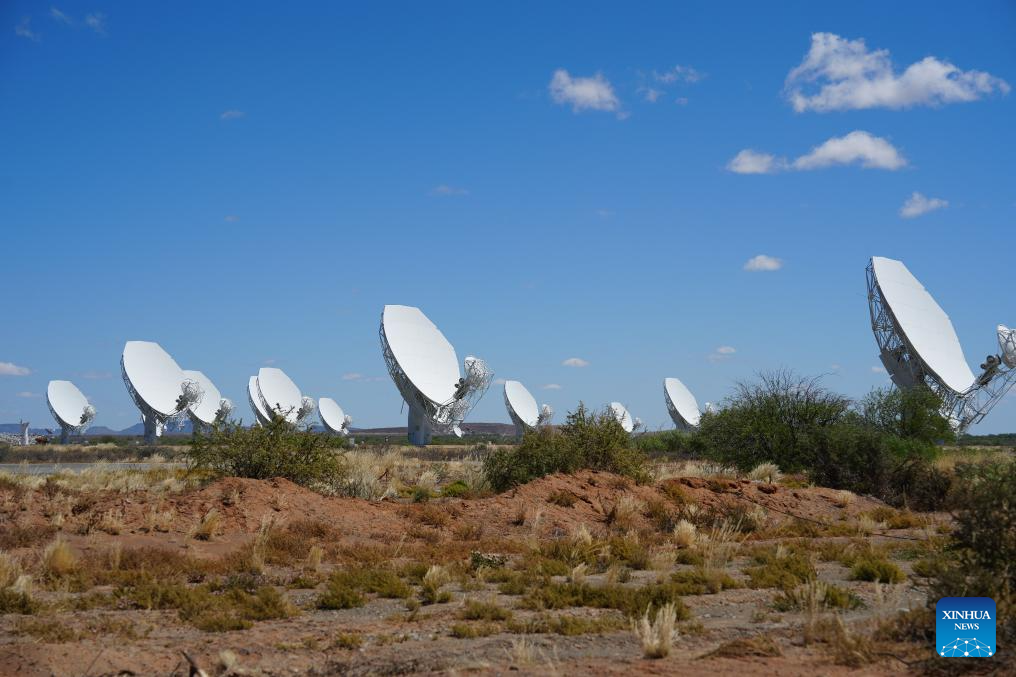
This photo taken on Sept. 24, 2025 shows the antenna array of MeerKAT radio telescope in Carnarvon, Northern Cape Province of South Africa. (Xinhua/Wang Lei)
CAPE TOWN, Dec. 4 (Xinhua) -- South African researchers have discovered the most distant ultra-steep-spectrum radio halo ever observed.
According to a statement issued by the South African Radio Astronomy Observatory (SARAO), a team of South African scientists using SARAO's MeerKAT radio telescope spotted a rare and extremely faint radio glow coming from a huge cluster of galaxies about 7 billion light-years away.
This type of glow, called an ultra-steep-spectrum radio halo, is the most distant one ever found.
The discovery was led by Isaac Magolego, a PhD student at the University of the Witwatersrand (Wits), in collaboration with his supervisors, Professors Roger Deane and Kshitij Thorat of Wits and the University of Pretoria.
Their results have been accepted for publication in Monthly Notices of the Royal Astronomical Society: Letters.
The newly identified glow lies at the center of the galaxy cluster SPT-CLJ2337-5942, a system with a mass roughly a quadrillion times that of the Sun. Such radio halos form when highly energetic particles interact with magnetic fields in galaxy clusters, often stirred up by the turbulence created as enormous clusters collide.
"At first, I thought this was a normal radio halo," Magolego said in the SARAO statement. "But the detailed analysis revealed something far more unusual: the most distant ultra-steep-spectrum radio halo ever detected. It's incredibly exciting."
According to him, the shape of the radio glow also closely matches X-ray images of hot gas in the cluster, confirming the strong link between turbulence, magnetic fields, and energetic particles. Because the hotter Big Bang afterglow in the early universe makes it harder for such halos to shine, finding one at this distance provides valuable insight into the conditions of the young cosmos.
The result stemmed from the MeerKAT-South Pole Telescope survey, a major international project combining MeerKAT's world-leading radio sensitivity with high-frequency observations from the South Pole Telescope, a 10-meter-diameter telescope at the Amundsen-Scott South Pole Station in Antarctica.
The MeerKAT telescope, operated by SARAO in South Africa's remote Karoo region, is composed of 64 radio dishes. It's a precursor to the Square Kilometer Array (SKA), which will be the world's largest telescope when it commences science operations around 2028.
The South Pole Telescope (SPT), led by the University of Chicago with partners across the international SPT Collaboration, conducts high-frequency observations of the distant universe. ■
This photo taken on Sept. 24, 2025 shows the antenna array of MeerKAT radio telescope in Carnarvon, Northern Cape Province of South Africa. (Xinhua/Wang Lei)

This photo taken on Sept. 24, 2025 shows the antenna array of MeerKAT radio telescope in Carnarvon, Northern Cape Province of South Africa. (Xinhua/Wang Lei)


